
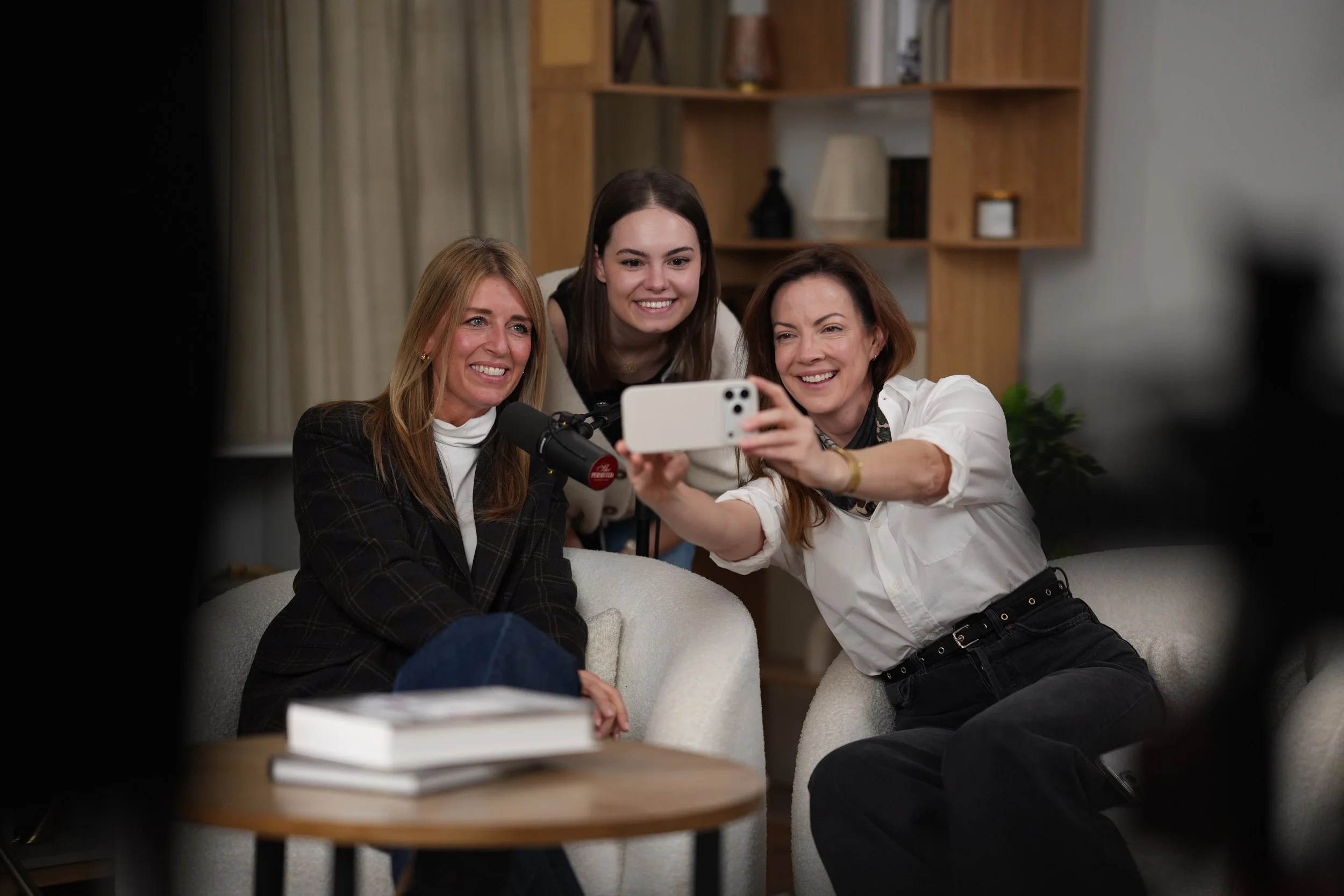
do you struggle with procrastinating… even on things you truly care about?! are you aware of your worst procrastination habits but don’t know how to change them?
in this episode, i am once again joined by dr. sarah olivo and dr. liz seidler— two clinical psychologists and hosts of the college is fine, everything is fine podcast who've helped students navigate the highs and lows of college for over a decade.
this episode breaks down WHY we tend to procrastinate and HOW we can get things done more efficiently (and without all the self-judgement). whether you’re a college student who’s avoiding those upcoming assignments, a post-grad who can’t seem to balance work with life, or a life-long procrastinator hoping to change your ways, this episode is full of science-backed tips for getting things done.
we talk about:
01:28 why we procrastinate on things we care about
04:03 how you can struggle with procrastination and still be high-functioning
09:33 if procrastination is a motivation problem (or an emotion-regulation one)?!
16:20 the relationship between ADHD + procrastinating
19:09 whether you can be a perfectionist and still procrastinate
25:05 what makes college students more likely to procrastinate
33:28 tips on how to stop procrastinating + get things done!
44:11 reminders for people who are hard on themselves about their procrastination
mentioned:
• college is fine, everything’s fine podcast
• college is fine, everything’s fine on instagram
• college is fine, everything’s fine on tiktok
quote: PROCRASTINATION really is an EMOTION REGULATION problem.
[00:00:00] Sarah: You don't know where to start and you're feeling overwhelmed. You've predicted failure already. You don't have the skill yet, and it feels embarrassing to admit that to someone. It kind of looms in front of you or you feel like you have to get it right.
[00:00:11] Liz: We do tend to procrastinate more about things that we deeply care about.
[00:00:14] Is procrastination a motivation problem?
[00:00:17] Sarah: This is laziness. Yeah. How do we help motivate them? It gets such a bad rap.
[00:00:22] Liz: Procrastination really is an emotion regulation problem. Reframing it that way is helpful to figure out, like, or what do we actually do about it?
[00:00:29] Sadie: Dr. Sarah Levo and Dr. Liz Seidler, you guys are clinical psychologists. You've spent over a decade helping college students and young adults navigate their mental health.
[00:00:38] thank you guys so much for being here today on She Persisted.
[00:00:41] Liz: So
[00:00:41] to
[00:00:41] be here, Sadie.
[00:00:43] Sadie: we were talking about something today, that
[00:00:44] Somehow in 260 plus episodes, there's not been an episode dedicated to, and yet it's probably one of le-
[00:00:52] like
[00:00:52] number one things that I struggle with, which is procrastinating.
[00:00:56] Mm-hmm. You guys mentioned that you have this conversation multiple times a week every single week. Mm-hmm.
[00:01:01] It's something
[00:01:01] that lots of people struggle with, and so I'm really excited to dive into this, and especially talk
[00:01:07] about
[00:01:07] the dialectic and the confusing part of procrastination- Yeah.
[00:01:12] Mm-hmm ... that sometimes you can really care about the
[00:01:15] thing
[00:01:15] that you're procrastinating. It can really matter- Mm-hmm ... to you. You know it's important, and yet you're still like, "Later, next week, next month."
[00:01:22] Sometimes that's,
[00:01:23] the more you care, the bigger the procrastination- Right.
[00:01:26] Liz: Yes ...
[00:01:27] Sarah: the need.
[00:01:27] Sadie: Yeah.
[00:01:28] Sarah: Yeah.
[00:01:28] Sadie: from your guys' perspective and experience, why do we procrastinate things that we do care about?
[00:01:34] Liz: lack of motivation or diff- like, difficulty with procrastinating is probably the, the biggest referral kind of question that I have, right?
[00:01:42] Really. , And especially from parents. Yeah. , And I think what's really helpful is to view it from a different lens, that procrastination really is an emotion regulation problem. So we do tend to procrastinate more about things that we deeply care about, and we need to ask ourselves, like, what is the emotion that we're feeling that is getting in the way of us procrastinating?
[00:02:01] Mm-hmm. ,
[00:02:01] Reframing it that way is helpful to figure out, like, oh, what do we actually do about it, right? Mm-hmm. , And in general,
[00:02:07] most
[00:02:07] things around mental illness, I would say, are related to
[00:02:10] things
[00:02:10] we care about. We tend to be anxious more about things that we care about. It's not a surprise that we procrastinate around things that we, you know, are really
[00:02:19] committed
[00:02:20] to.
[00:02:20] Sarah: Yeah. The more it kind of looms in front of you or you feel like you have to get it right, then a lot of times I think about the things that come up that almost aid in procrastination, right? it's, okay, well, I have to be really awake and alert when I start this. Mm-hmm. Or I have to make sure that I've done all the research I possibly can.
[00:02:39] Right. Or, you know, there's just- Rules ... certain rules that I think that can almost aid and abet- Mm-hmm ... the procrastination. I also think there are times, too, where- It gets such a bad rap because people think procrastination and oftentimes, especially if it's a referral from a parent, it comes from some version of concern-
[00:02:58] Liz: Yeah
[00:02:59] Sarah: about what this means and why they're doing it. Mm-hmm. How do we help motivate them? Or it comes with some sort of values judgment, like this is laziness. Yeah. We want them to just get started. Yeah. , And, and oftentimes when you start to piece meal out, like if you sit down with somebody and you're like, "All right, give me a before, before kind of,
[00:03:18] like
[00:03:18] what's happening before you have this event, this paper, this project, this phone call, this conversation," whatever it is, you get a sense of what is actually the function of it, right?
[00:03:29] Is it regulating an emotion because you don't know where to start and you're feeling overwhelmed? Is it regulating an emotion because you've predicted failure already? Is it- Mm-hmm ... something where you don't have the skill yet, you know, and you don't know how to describe that, , and it feels embarrassing to admit that to someone?
[00:03:47] So a lot of times when you really start to pull apart
[00:03:51] the
[00:03:51] little pieces of it, you find out that this word procrastination actually, it's almost like a giveaway word for a lot of things- Yeah ... that can be very different depending on the person- Mm-hmm ... or the family dynamic-
[00:04:03] or the school,
[00:04:03] or the school,
[00:04:03] Sadie: Yeah. That's so interesting, and I'm almost surprised that that's,
[00:04:06] like
[00:04:06] the number one presenting concern, if you use the official terminology. Because when I think about,
[00:04:13] like
[00:04:13] what really has compelled me in the past to try and do something differently, and also what compels people to ask for help and reach out and, and make a shift, normally it's,
[00:04:24] like
[00:04:24] the distress and impairment
[00:04:26] piece.
[00:04:26] Mm-hmm. And,
[00:04:26] like
[00:04:27] that's really there with diagnoses and when you're like, "This is becoming clinically significant," versus, "This is a challenge. We can work to overcome it, but it's not derailing life." And with procrastinating-
[00:04:39] You
[00:04:40] can be motivated, you can show up in a lot of other areas, but you can also procrastinate excessively.
[00:04:46] Liz: Yeah.
[00:04:47] Sadie: I moved in July. I need to switch my car insurance. I know what car insurance I'm gonna switch to.
[00:04:53] Liz: Classic.
[00:04:54] Sadie: It's gonna expire in December. It still hasn't happened yet.
[00:04:56] Sarah: Mm-hmm.
[00:04:57] Sadie: It moves every single week on my Google Tasks.
[00:04:59] Sarah: Yep. Yep.
[00:05:00] Sadie: I know that it probably would like maybe even be less expensive- Yeah
[00:05:03] if I switch. Hasn't happened.
[00:05:05] Sarah: Yeah.
[00:05:05] Sadie: , but I go to work. I do things. Mm-hmm. I am productive in other areas, and so I'm surprised to hear that that is something that is top of mind when people come to therapy because it is something that can be very functional in some people's lives.
[00:05:21] Liz: Right. Right. I think it's because at- at least in my experience, our society's really outcomes focused.
[00:05:27] Sadie: Yeah.
[00:05:28] Liz: So, , to me some of the
[00:05:30] distress
[00:05:30] is like the process of life, right? , And people are less focused on that. Mm. They're really focused on, , getting their kid into a good college, right? And they're procrastinating on their... I mean, this is timely. You know, people are still writing essays and supplementals, right?
[00:05:44] And the parent's focused on that, let's say, versus, , what's getting in the way of them completing it, right? If they started two years ago and they're still not there, maybe there's some obstacle that's worthwhile kind of exploring. So I really think that's why I see it a lot, right? Is a- and or inherently, like people just being worried, "Is there something really wrong with me?"
[00:06:03] Mm-hmm. They don't realize it's a really normative process, procrastination.
[00:06:05] Sarah: I always am... I mean, I feel like I'm saying that a lot in my sessions or we say it a lot on our show. It's, it's like if we had a magic pill to make these things work, we would be billionaires.
[00:06:15] And then also anyone who says they have a magic pill is lying or selling you something. yeah the emotional piece of it that it's trying to fix, which is dread- Mm-hmm ... and putting things off. Mm-hmm. Our mind it's instinct is always to help save us in some way-
[00:06:29] Liz: Right ...
[00:06:30] Sarah: from something. So if, if it, if we feel anxious, it wants us to avoid the task kind of instinctively. If we feel sad, it wants us to withdraw and kinda isolate.
[00:06:37] If we feel... Right? It's, it's trying to help us ultimately, and so you think about procrastination-
[00:06:43] Liz: Mm-hmm ...
[00:06:43] Sarah: our mind's gonna be amazing at giving us all sorts of reasons why we don't have to do it. Right. So, , the excuse generating machine is something that we talk a lot about. I don't know if that's ever something you've explored.
[00:06:54] No ... but, you think- But But I
[00:06:55] Sadie: have that. Never heard of it- Oh ...
[00:06:56] Sarah: but I have
[00:06:56] Sadie: that.
[00:06:56] Sarah: Oh, I have it so big time, right? Where it's just sort
[00:06:59] of
[00:06:59] like, let me think of all- ... the reasons that I don't need to do this task, and so I need to, like I definitely need to do all those dishes. I definitely n- you know, whatever is less dreadful for it.
[00:07:10] And so the excuse generating machine is ready to go to save us from that emotion without judgment, right? Because then we get to come in and say, "Well, you know, here's all the reasons that I didn't do it."
[00:07:21] Liz: Yeah.
[00:07:22] Sarah: , I also think... I mean, a lot of times even in my session, once I've introduced that concept or even with my kids, it's sort of like, "All right.
[00:07:29] What's the excuse generating
[00:07:31] giving
[00:07:31] you? Let's just get it out. What is it? It's saying this. It's saying this. It's saying this. All right. Thank you. Thank you, brain, for trying to help save me from this horrible task or this dreadful, mundane thing or this scary thing I need to do. All right. Now where do I, do I want that to be the reason-
[00:07:45] Sadie: Mm-hmm
[00:07:46] Sarah: I'm making
[00:07:46] choices?
[00:07:47] I think we all should be
[00:07:48] very
[00:07:49] aware of like what our excuse- Yeah ... generating machine, what our go-tos are-
[00:07:53] Liz: Mm-hmm ...
[00:07:53] Sarah: for it.
[00:07:53] ,
[00:07:53] but you also mentioned something that made me think- And maybe it was your GEICO thing. It just kind of popped into my head, where a lot of times, especially when we're in, in families or when you have friends who are trying to think something through and other
[00:08:06] people
[00:08:06] are labeling or saying the procrastination- Yeah
[00:08:09] is the problem, it's because they've decided it's a problem for them. There are times where, for instance, yes, maybe you're, you're procrastinating on the GEICO thing.
[00:08:19] Sadie: Allstate.
[00:08:20] Sarah: Not- GEICO can sponsor. Uh- No,
[00:08:23] Liz: it's Allstate.
[00:08:24] Sadie: Yeah.
[00:08:24] Sarah: Oh, sorry.
[00:08:25] Sadie: GEICO's too expensive-
[00:08:25] Sarah: Allstate ...
[00:08:26] Sadie: bad premium monthly.
[00:08:28] Sarah: God, GEICO, get it together.
[00:08:29] Lower your
[00:08:30] premiums
[00:08:30] for Sadie, then maybe she would do it.
[00:08:32] Sadie: See?
[00:08:32] Sarah: ,
[00:08:32] I think
[00:08:34] I'm just
[00:08:35] trying to get us a deal with somebody.
[00:08:36] right?
[00:08:37] We're trying to look for sponsors.
[00:08:38] I think that sometimes you'll have parents come in and, like, they're procrastinating, they're procrastinating, and really it's they're, they're managing
[00:08:45] their
[00:08:45] time in their own way.
[00:08:47] Mm. And so for all I know, right, yes, on the one hand, this is on your list and it keeps on getting shuffled to the side, and yes, you probably could just do it and it would feel like a lot of relief.
[00:08:57] Sadie: Yeah.
[00:08:57] Sarah: I also think there are times too where I have to put something off. It might even be inconveniencing someone else, but I am trying to manage a lot of different- Yeah
[00:09:04] things, and I, I need to put that to the side. So it's a planned time management strategy as opposed to procrastination. Mm-hmm. So I don't know if you have that in times where people are labeling it themselves as procrastination or laziness or-
[00:09:18] Liz: Yeah ...
[00:09:18] Sarah: what have you. And you're like,
[00:09:19] "Well,
[00:09:19] maybe,"
[00:09:20] you
[00:09:21] know?
[00:09:21] But again, what's-
[00:09:21] Sadie: still
[00:09:22] technically insured, so it doesn't need
[00:09:24] Liz: to be done yet. Mm. Yeah.
[00:09:25] Yeah.
[00:09:25] Sarah: Actually,
[00:09:25] it's just-
[00:09:25] you're
[00:09:26] gonna, at
[00:09:26] some
[00:09:26] point.
[00:09:27] Liz: I'm putting this in my calendar, Sadie. I'm gonna
[00:09:29] you
[00:09:29] a reminder in a couple months.
[00:09:32] Sadie: Oh, my goodness.
[00:09:33] Liz: Yeah.
[00:09:33] Sadie: You guys mentioned two things. One, I have a clarifying question about, which is, is procrastination a motivation problem?
[00:09:42] Like-
[00:09:42] is that what's happening- Mm ... and that you're not motivated enough to do the thing? Or you also mentioned that it's an emotion regulation issue. It's not just this, like, other behavior and thing that it's occurring, but it's this emotional cycle that is preventing the outcome from
[00:10:00] happening.
[00:10:01] Liz: I, you know, there's a New York Times article, and I'm gonna forget the researcher on this, but I always, I send this to college students, I send this to parents, I am of the mindset, and again, I don't, I'm not the sole proprietor of truth, I don't own the truth about this, but I really do think it's an emotion regulation problem.
[00:10:16] Mm-hmm. That, , there is an emotion that's attached to a task that's making it difficult for you to complete the task, and I think this varies, - I'm sure if we looked at various brains, that people are kinda just born with, like, more resiliency towards being able to do tasks that difficult emotions are associated with, right?
[00:10:34] Yeah. And that are... might be, like, lower reward, like
[00:10:37] calling
[00:10:38] Allstate. , But-
[00:10:39] Sarah: You just need to up the reward for it.
[00:10:41] Liz: Right. Literally. , But usually there's an emotion. Like, if I assign that a task is gonna be, like, incredibly challenging or difficult or impossible to complete, that is going to lead to an emotion, let's say, like dread, and that's gonna be more challenging for me to get initiated on the task.
[00:10:59] You know, I th- and I
[00:11:00] think
[00:11:00] about this specifically when I think about writing my dissertation and the dissertation process. And if I look at my graduating class and kind of how everyone kind of approached the dissertation, , the attitude towards the task, right, the emotions that they kind of had towards the project was directly, I think, related to completion rates and maybe success or not success and length of time, right?
[00:11:25] So when I share that, I think it's empowering to know if we can change your mood state, your mindset, right, that is a much more solvable problem than this concept of motivation,
[00:11:39] Sarah: So when I hear people talking about low motivation or even when people say like, "I have to, I have to be hard on myself or else I
[00:11:48] won't be
[00:11:48] motivated,"
[00:11:49] I immediately start to think about this little parable. Is that right? Yeah. A fable and parable?
[00:11:55] Sadie: I get all of those words confused.
[00:11:56] Sarah: Oh, Mr. Gill, my eighth grade English teacher would be so pissed. And actually you say metaphor and every now and then- I know ... I hear my voice being like, "Is it a simile?"
[00:12:03] Sadie: I know. Mm-hmm. I don't
[00:12:04] Sarah: know. You know? I know, I- I know for a record, I want my St.
[00:12:07] Mary's-
[00:12:07] Episcopal School girls to know I'm aware that sometimes I'm s- talking about a simile.
[00:12:12] All right. I've given the caveat. , But you think about a donkey who has to take a journey, right? His job is to get from point A to point B, from the farmer's, you know, farm and the field and to bring the wares to market, and he's gotta get there, right? That's what he's there for, and so he's gotta go from point A to point B.
[00:12:28] And if you have kind of a big, heavy load, and you have someone who is kind of putting, , all the wares on your back, and you've gotta go, and it's a hot day, it's gonna be a hard journey. So you've got the rocky road. Your feet are gonna hurt. The donkey's gonna feel hot. He's gonna get tired. And if you have a farmer who's just, like, giving you, you know, this poor donkey, a stick to the butt every time he pauses, he's gonna lurch forward, right?
[00:12:52] And he's gonna
[00:12:52] finally
[00:12:53] do it, but he's gonna get there. He's gonna feel drained. He's gonna feel tired, depleted. If you have the same exact journey, right, but the only thing you do is have a different farmer, right, is saying to him, "All right. I'm loading you up. It's a rocky road. It's the same distance.
[00:13:09] It's still really hot, but here's a carrot. So every time you get tired, here's something that's gonna be worth you taking that extra step." So that donkey can get there, and he's, might be tired, but he feels more nourished. He feels like, "Okay, I was feeling rewarded and acknowledged for this. It was something worth the journey."
[00:13:27] , And I think so many people when they think about procrastination, a lot of times it's because they're only using the stick, right? Or someone else is giving them the stick. And it's like, all right, so if you're not motivated, , maybe it's 'cause you don't have a carrot. You only have the stick. What is the thing that's gonna make you feel like it's worth doing this?
[00:13:48] Liz: Mm.
[00:13:48] Sarah: And so if you start to work with them on that, it's less about how dreadful it is. It's more like for you it might be like, okay, imagine the relief you will feel when you can text Liz and me- ... to say that you've done it, and we're gonna have, like... Or we're gonna do all the, like, you know, message balloons and things like that.
[00:14:08] And you have a good laugh about it. And it'll be, you know, like that. I know that's gonna be what gets you over the edge.
[00:14:14] Liz: That was great, Sarah
[00:14:15] Sarah: Wow. Thanks. That's my donkey I did the donkey.
[00:14:19] Sadie: So when someone is procrastinating, maybe
[00:14:24] they're
[00:14:24] using
[00:14:25] the stick, maybe they're trying to put these rewards in place,
[00:14:28] they're
[00:14:29] not doing what they know they should be doing, the motivation isn't there. Do you have to figure out why they're avoiding it, why they're procrastinating? Do you need to understand that, like, well, there's a m- this emotion attached to it, or You've already figured out what the outcome is, so you've decided not to do it, or you can just kind of reverse engineer, like, well, what would get me there?
[00:14:47] Sarah: I always think, I don't know about you, but I feel like If we can find out why, that gives
[00:14:52] us
[00:14:52] the roadmap.
[00:14:53] Sadie: Mm.
[00:14:54] Sarah: - A lot of times though, the person I'm working with w- doesn't necessarily know why.
[00:15:02] Sadie: Mm-hmm.
[00:15:03] Sarah: Right? Maybe they're still trying to kind of gain some insight, or things are so overwhelming that they feel like there could be a thousand reasons. And so that's also something to say, "Well, we can still create a system without trying to figure out why." So yes, if we can figure out what you're trying to avoid, get to the bottom of what...
[00:15:20] You know, if it's perfectionism, for instance, so I will not be able to do this until it's perfect, and we figure that out, and we think, "Well, okay, how do you get to perfect? What does that look like? What are the pros and cons for doing that?" Then we can start to say, "All right, now we know maybe some strategies to help you, , think through when is striving feeling really healthy for you and when is it keeping you stuck."
[00:15:44] And then we can s- work with some skills. Like, healthy striving is good. , Working towards a perfect outcome is probably gonna keep you never feeling satisfied. So we can find that balance. A lot of times though, we, for whatever reason, they're procrastinating, and it's, there's not time to figure that out, or lack of insight, or the parents are saying, "Here's a consequence," or a school is saying, "We have to get to it," then we can say, "All right, how can we put in some systems to increase some version of a reward for you, to kind of manufacture some, some rewards, some, systems that feel like it's gonna propel you, right?"
[00:16:20] Or we can think through, yes, is the why that, that you don't have enough supports right now, right? So okay, we figure out how to get you some supports. I will also say the why is really important, and I think procrastination for people who have, right at this point, we would say neurodiverse or have ADHD specifically, that they have a totally different reward system.
[00:16:43] We know recently from a, an article in Cell, which I mean, did I have AI help me translate it? Yes. No, I'm kidding. It's like it was a little dry. , But really what it's saying is people with ADHD do not have the same dopamine levels, and that we know now that the medication that's commonly prescribed, what it does is it actually regulates the dopamine so that they feel more of that reward for mundane tasks.
[00:17:08] So if I'm talking to someone who's anxious versus someone with ADHD, that why really matters, because they are genuinely not getting- Mm ... the same chemical regulation that someone else is getting. So yeah, I think it's important. And if not-
[00:17:22] I
[00:17:22] don't know. Do you ever have times where you
[00:17:24] kinda
[00:17:24] have to work backwards?
[00:17:25] Liz: I was gonna say, the only thing I would add to this, and this partly applies to not just procrastination, but when I'm working with college students, I always want to talk about the time that they have success first.
[00:17:37] And
[00:17:37] I think it's really helpful to know that there are times that you have the urge to procrastinate and you don't.
[00:17:43] And
[00:17:43] what are some ingredients that are kind of in that recipe of success that we can think about are not in other circumstances, that we can kind of figure out, okay, like, maybe, , okay, you have a course with a professor. You don't like the professor, right? You don't like the material that you're learning, right?
[00:17:59] , And those are the classes that you procrastinate more in, but the classes where you're really interested or you like the material or you have a friend in the class,
[00:18:05] like
[00:18:06] there's sometimes things that we, that kind of help us resist urges to procrastinate that I think are really helpful to kind of know.
[00:18:14] , and then I'm all for structuring the environment first to a way to
[00:18:17] kinda
[00:18:17] set somebody up for success first before unpacking this, like, deeply rooted core belief that you're, you know, lazy and unmotivated and you're gonna live, you know, on the side of the street and have 27 cats.
[00:18:30] Like, whatever,
[00:18:31] like
[00:18:31] story that you have about your future or something that's,
[00:18:34] like
[00:18:34] inherently flawed about you. If we can structure the environment in such a way that you are more likely to be able to resist an urge to procrastinate, that's preferable, right? , Kind of like sleep. I always say, like, if we can get the room dark and
[00:18:46] we
[00:18:46] can kind of, like, get a noise machine on and, and you're sleeping better, that's great.
[00:18:51] That's, those are, like, simpler kind of solutions. But I would say those are the only two things I would add to what you say. But,
[00:18:56] like
[00:18:57] the why matters because, , at least in a clinical way sometimes when you're working with college
[00:19:01] students
[00:19:01] 'cause the intervention's gonna just look different.
[00:19:03] Sarah: Yeah.
[00:19:04] Sadie: Then you have the momentum, then they are actually motivated- Right, yes
[00:19:07] and then it's easier.
[00:19:08] Liz: Right, right, right.
[00:19:09] Sadie: How do you help people figure out if they have high standards or if they're being a perfectionist, and that's potentially getting in the way of them ever getting something done or completed or good enough?
[00:19:21] Sarah: When someone has perfectionism, oftentimes the idea of you are or are not a perfectionist can feel like a never-ending debate because they are going to feel attached to that. , Sometimes you can say where is it, , a, a mood issue versus where is it a value or something you feel like is a really good quality about yourself.
[00:19:45] And so I try to say, "All right, which one is a move towards the person you wanna be versus some other kind of, again, stick piece of like I've gotta get it
[00:19:54] right
[00:19:55] or else I'm gonna feel like a failure?" , I think that
[00:19:58] oftentimes
[00:19:58] instead of like are you a perfectionist or not, I mean, some people come in and they will self-describe that.
[00:20:03] If you start to try to say to them, "Hey, I think you should probably... I think you're a perfectionist, and I think your, our goal is gonna be for you to be a little less perfect," I mean, there's gonna be like a person-shaped hole in the door. So it's more about saying like, "When is this working for you, and
[00:20:17] when is
[00:20:17] it not working for you?
[00:20:18] And then let's, let's at least go and start with the times where it's not working for you so much, and then we might be able to redefine or share some, awareness of like when you try to reach this goal, if you achieve it," right? "If you achieve it, you feel good for a second, and then that tends to go away.
[00:20:36] Or you say, 'I
[00:20:37] achieved
[00:20:38] it, but only because the test was simple,'" right? Or if you don't achieve it, it becomes, "I'm a failure." Mm-hmm. "I
[00:20:47] I have
[00:20:47] to try harder." And so no matter, with this mindset, no matter what you do, you can see that you're always having to work harder to achieve the feeling of I, "I got it done."
[00:20:59] Right. And if you sort of say that to them to say, "Wow, like you're kind of-" Doing
[00:21:04] these behaviors in order to feel like, the relief. The relief either never comes, or it comes so briefly, but only in a way that makes you have to work harder or just as the next time right So let, you know, sort of like let me know where that feels
[00:21:18] exhausting.
[00:21:19] Liz: Yeah. Yeah. The way I usually know is I try to do a task they're avoiding in session, and then it's really clear if they're perfectionistic or not. You know, sometimes you'll just see the avoidance, and I'll be like, "Okay, let's write that email to your professor," right? Asking to set up a time for a meeting.
[00:21:33] People who are not perfectionistic, it takes 10 seconds, and then they're usually like, "This is stupid. I should've just sent it," blah, blah, blah. Perfectionists are like, I had a client recently, like three different AI platforms that they were putting the message they typed in into those platforms,
[00:21:48] voice
[00:21:49] memoing
[00:21:49] it, listening to
[00:21:50] it out
[00:21:50] out loud, asking me to re- like, like so many thing...
[00:21:53] And they're like, "Yeah, I'm just gonna do it. I, I still don't know exactly what I wanna say to them." I'm like, " I think you wanna set up an appointment, right?" And if we could just go through how many words to make that sentence, right? But perfectionists, they, there's always a fear that they're gonna do one thing wrong, right?
[00:22:11] And so they need to,
[00:22:13] like
[00:22:13] rehearse. And usually I can see it a lot just by trying to start a task that they're avoiding in session. And I'm like, okay, there's some rules and beliefs and assumptions and a lot of,
[00:22:23] like
[00:22:23] over-worrying that's happening that we need to work on- Mm ... versus,
[00:22:27] like a
[00:22:27] just do it kind of approach that people who are not perfectionistic.
[00:22:31] You know, their avoidance is serving a different function.
[00:22:34] Sarah: You definitely see certain, certain behaviors- Yeah ... happen that feel familiar, right? Sort of like, so never feeling satisfied with the result. , Over-researching things where at some point you just see there's a diminished return on their investments.
[00:22:48] Mm-hmm. Or asking other people to , check to make sure, Did I do this okay?" Yeah. Rereading things that feel like, all right, is it, how many... Yes, reread an email once, you can catch a spelling error. But,
[00:22:59] like
[00:22:59] at what point, you've read this this many times- Right ... it's almost like you're magically looking for the failure secret that's in there that you can't find.
[00:23:07] So it's almost like trying to build up some certainty that they're gonna do something beautifully. Yeah. And it's really about- increasing tolerance of -
[00:23:16] Liz: Right ...
[00:23:17] Sarah: the unknown or tolerance with disappointment, , or tolerance with an ability to handle things if you don't do it well.
[00:23:23] Sadie: Yeah.
[00:23:24] Sarah: So kind of helping them practice making mistakes, for instance.
[00:23:28] Mm-hmm. And to say, "Okay, let's, let's actually purposefully make a mistake. We can start small and just have you sit with that for a minute." , But a lot of times, yeah, you'll start to see that real significant difference between how distressed they are about things and how long they stay distressed. You know, like, I'll hear someone say they failed something, or I bombed it, and I have to always say, like, "What's your vers- what's your definition of bombing?"
[00:23:51] And I guarantee you, a lot of times, at least with the clients that come to, end up coming to us a lot for this purpose,
[00:23:56] it's,
[00:23:56] it's a B, anything below an A minus. And then it's like, okay, for you that's failing. I hear that, but it's not the definition of-
[00:24:04] Sadie: Cs get degrees ...
[00:24:05] Sarah: Cs get degrees. Cs get degrees. Yeah.
[00:24:07] Yeah, that's true.
[00:24:07] Sadie: Exactly. , when I think about procrastination typically,
[00:24:11] and,
[00:24:11] like, most of the time when I'm procrastinating things, it's that avoidance piece of, like, maybe there's, an uncomfortable emotion or the task isn't enjoyable. Mm-hmm. It's like a just avoiding of the thing. And I remember having a conversation with someone on the podcast who worked with patients who had ADHD.
[00:24:30] Mm-hmm. And he was talking about how procrastination also can be really effective and a reason why people do it is because when you get close to your deadline or when you get close to the, like-
[00:24:42] Liz: Yeah ...
[00:24:42] Sadie: there's no more pushing this back, you've created this, like, artificial stressful environment. Yeah. And then the adrenaline forces you to do it.
[00:24:50] And
[00:24:50] then you're more motivated.
[00:24:51] Liz: Mm-hmm.
[00:24:52] Sadie: A self-reinforcing cycle.
[00:24:54] Sarah: Mm-hmm.
[00:24:55] Sadie: What do you guys see? Is it one that's way more common than the other? Is it important to understand, like, which bucket you're falling into? How do you kind of tease that apart with people?
[00:25:05] Liz: I think, and it's interesting, I was talking to someone about, like, the difference between, I think this applies, high school and college.
[00:25:11] Sadie: Mm-hmm.
[00:25:12] Liz: where college students see a lot of procrastination that they didn't have in high school. And we were talking about how high school, and it really, it makes me anxious for my kids to go to high school, but, like, there are s- not enough hours in the day in high school, right?
[00:25:31] If you play a sport or do some activity that requires a lot of your time outside of school, There's
[00:25:36] not a lot of room for procrastination. There's a lot of also, like, you see the same people every day. The teachers are like, "Hey, Sadie, you forgot to do this," right? Like, there's just circumstances that create pressure, right?
[00:25:49] So that time
[00:25:50] pressure and the environment that kind of sets us up for, like, accountability and not having enough time creates this level of stress and pressure that I think
[00:26:01] both a- across the spectrum in terms of whatever your kind of neuro pathways look like, kids are more successful in high school in resisting procrastination.
[00:26:12] And then they get to college, where if you really look at the amount of hours you are in class compared to when you are not in class you have so much time-
[00:26:21] Sadie: Yeah ...
[00:26:22] Liz: to come do your work. , Which be- creates, like, this,
[00:26:24] like
[00:26:24] breeding ground for procrastination to really, really, really grow. ,
[00:26:29] And
[00:26:29] I think the difference...
[00:26:31] I always go back to, like, what do the interventions look like? It kind of... I do think it looks very different for someone who has executive functioning deficits versus somebody who is avoiding for emotional reasons. , Because that time pressure piece that I'm kind of speaking about, , is when individuals with executive functioning, they thrive, right?
[00:26:53] So if we're in a new environment in college where it doesn't really lend itself to having a daily time pressure to kinda get things done, it's gonna cause a lot more challenges, I think.
[00:27:05] Sarah: I think that one of the strategies too can be, like when you go to college, right?
[00:27:10] And
[00:27:10] we have students who will say like, "Oh my gosh, the, the l- amount of time almost feels like too much. I don't know what to
[00:27:15] Yeah. It's
[00:27:16] It's
[00:27:16] optimized
[00:27:17] for avoidance.
[00:27:17] Sadie: I'm not used to it. Yeah.
[00:27:17] yes.
[00:27:18] ,
[00:27:18] Sarah: , they almost has anxiety like, "What do I do with all this free time?" Yeah.
[00:27:22] , That's not everybody, right? I was just like, "I got all
[00:27:24] kinds
[00:27:24] of... I
[00:27:25] was
[00:27:25] not worried about it." And my freshman grades reflected that.
[00:27:28] but I think that one of the things that can happen, or even just like a practical strategy. Yeah, yeah. 'Cause a
[00:27:33] 'Cause a lot
[00:27:33] of the things we're talking about here is like, okay, it's theory, right? Great. We know this, we know that, we know why. But what do you do about it? And I think
[00:27:39] sometimes
[00:27:40] creating a closer connection to the reward, even if it is a little bit
[00:27:47] manufactured,
[00:27:48] is, is a good thing.
[00:27:49] So we know that if the reward is right in front of us or the pressure time is right there, it's easier for us to pay attention to it. If not, our attention can kinda go all over the
[00:27:59] Yeah.
[00:27:59] And so
[00:28:00] how
[00:28:01] do you create more awareness of a deadline, more of a reward for getting something done?
[00:28:07] And it might be for some people breaking something down to every time you get a little piece done you get to reward yourself with a break. Or it's pairing it with somebody who does have a different skill set than you. Mm-hmm. So the same way that we must pair, although some of our skill sets we both, we're just like, "We're both too busy."
[00:28:26] I mean- We
[00:28:27] Liz: are, we are deficient-
[00:28:28] Yeah ... in
[00:28:28] some areas- Yeah ... collaboratively.
[00:28:29] Sarah: Collab- Yeah. Thank God for our intern, 'cause I mean, that's- ... amazing. We just need an Emily to really round it out.
[00:28:35] Liz: Yeah.
[00:28:35] Sarah: More of a trio I'm realizing- Yeah. ... necessary. But I think that, if you know
[00:28:40] that
[00:28:40] you, for me for instance, I can procrastinate and it kinda comes out with poor time management.
[00:28:46] All right. It's not a skill set that I have naturally, as evidenced by earlier today. I think that it's about saying, "Okay, what systems can I put into place?" Yeah. Or h- let me have someone else tell me how much time I need to get something done.
[00:29:01] Liz: Mm-hmm.
[00:29:01] Sarah: Or- If you know that it's gonna be really hard for you to complete it or to follow through with the task, make yourself accountable in some way.
[00:29:09] I don't know where I heard this story, but there was somebody who was talking about it, , and she was saying, like, somebody who knew she wouldn't go to wor- a workout class and paired it with someone else who knew was, like, very much- Mm
[00:29:19] wanting to go, and really, that was her thing, and they would swap shoes. So that way sh- she said, like, "If I don't go, my friend won't have the right shoes for this, and so I'd have to make sure..." And so did she have to stay motivated all the time and wanna go? Yeah.
[00:29:34] No, she
[00:29:34] just had to say, "I need to pair it with something that's really important to me."
[00:29:37] Liz: Yeah. "
[00:29:38] Sarah: I will never disappoint my friend. That's a big deal." So her carrot, right, was, like, being a good friend.
[00:29:43] Liz: Yeah.
[00:29:43] Sarah: And she knew that that was gonna get her
[00:29:45] there.
[00:29:45] So sometimes you just have to create those systems- Mm ... and be like, "All right, it's, it's something that doesn't come naturally, or I need to manufacture a way for me to get this task done."
[00:29:55] , And I think that's completely fine to have some hacks.
[00:29:57] Sadie: Yeah. I also will say on, like, the high school piece as well, I think
[00:30:00] the
[00:30:00] nature of the work is so much more scaffolded and defined. Yeah. Like, a lot of the college things
[00:30:07] are like,
[00:30:07] do this super long reading or- I
[00:30:09] know ... work on this semester-long
[00:30:10] project.
[00:30:10] I know. Like,
[00:30:11] I look back to high school assignments, and it was like, "Do one worksheet." And I think that also lends itself to not only is there's all this time to expend and to, and avoid, but also the nature of the task is, like, a lot more difficult to just get started
[00:30:29] Liz: on-
[00:30:29] Sadie: Mm-hmm.
[00:30:29] Yeah ... because it's ambiguous, and undefined, and feels overwhelming.
[00:30:33] Liz: Right. Totally. I think that's when I'm telling someone, like, "Open up a Word document. Just write s- one sentence with me. Seriously, w- write one sentence." Yeah. "And then, like, we don't even have to meet for the rest of the session if you need to start going with the rest of your sentences, but, like, you've written one sentence, right?"
[00:30:48] But I think that is, again, I think some people naturally are able to kind of break like, bigger tasks into smaller tasks, and that's just, like, a skill set they have. And that's where I think a lot of college students drown a lot, because they don't have that skill set and/or, like, this reward system piece is just not in place, right?
[00:31:08] and the environment is, like we talked about, kind of not structured in a way that there is a lot of scaffolding.
[00:31:14] Sarah: Yeah. And it's amazing how much we just, I think, two things. One is some people can kinda go, and for whatever reason, either they're not worried about it and they kind of are fine- Wandering around the syllabus for a little bit and figuring it out, but some people get there, and I remember, actually, I don't know if you would remember this.
[00:31:31] It's one of our first episodes, and made my nephews basically be our guests- Yeah ... I pulled them in, and tonight I'm actually having dinner with the same nephew, so it's kind of fun for me to remember what he said, which is like, "I looked at the syllabus for the first time, and I saw all the work ahead of time," which is not typically what happens.
[00:31:50] I mean, yeah, you see a textbook, but- Yeah
[00:31:51] but you
[00:31:52] kind of learn you're gonna do it chapter by chapter.
[00:31:53] Sadie: Right.
[00:31:54] Sarah: And he said he went into a full panic. He just had no concept of how to go about it. and then here's, you know, four other classes or however many that he was looking at those things and just really struggled and felt like he couldn't handle it.
[00:32:08] He had not been taught how to do it, right? High school had done it for him in some way. So I think a lot of students assume other people have it figured out, right? There's really a, not nece- I mean, sometimes maybe certain schools are better than others. There's not really a, "Hey, let's look at a syllabus and plan it out together."
[00:32:27] Liz: Yeah.
[00:32:27] Sarah: College offices, obviously, most of the colleges do have some way to go in and get some help there. Yeah. So I really think that's another thing. People oftentimes don't wanna use it, or they don't think it'll be helpful, and like at the very least they're gonna be able to say, "Hey, here's how a lot of students break these things down."
[00:32:44] Mm-hmm. , but now, right, he, He did that, and he learned that once he procrastinated and wasn't doing well, he got some supports in place. He figured out what to do. He, he had one, you know, semester where he struggled. He was like, "I never want that feeling again." He's taking a Series 7. He has a, you know, a job here.
[00:33:03] I'm getting, I'm like, I'm getting a little, I'm like so proud of him. He figured it out, but it was a real, a real shift that he had to get through. Right. So, , I do think that a lot of times students who are feeling like, oh, procrastination is maybe a new thing for them, that's okay. That's normal.
[00:33:19] , You're being hit with a whole new system where you probably haven't had to learn the skills you need, but that doesn't mean you're not going to. Yeah. You just don't know
[00:33:27] Yeah ... them
[00:33:27] yet.
[00:33:28] Sadie: Are there any other tips and things that people can do if their procrastination is more on like the executive function side of like- Mm-hmm
[00:33:36] it's not that they're avoiding an emotion. There is that like, "I don't know how to reverse engineer the plan," or, "I've never had to do this before." , What do you guys advise people to do? What suggestions do you have when it's less the I'm avoiding this emotionally and more kind of the I don't have the skills?
[00:33:53] Liz: Yeah. Right. I have a couple thoughts about that. I love the Premack Principle, , for individuals that have executive functioning deficits, understanding that, like, the Premack Principle in psychology is that, we should be doing, , low reward task first and then reinforcing ourself with high reward tasks. Mm. And individuals with, with executive
[00:34:12] issues
[00:34:12] tend to do a lot of high reward tasks, right?
[00:34:16] Like- Yeah
[00:34:16] Yeah
[00:34:16] will say to me, they'll be like, " They're on YouTube, they're on playing video games, or are able to do these things, sustain their attention for a long period of time," right? So to me, it's
[00:34:25] like,
[00:34:26] how do you rewire things so that the behavior that you really wanna do is contingent on the behavior that you don't wanna do, and what does that look like for you?
[00:34:35] Does
[00:34:35] that mean that, behavior's contagious? For a lot of people, behavior is contagious, so do I, am I body doubling? Am I with a peer that's really on task and maybe, like, the anxiety of them seeing me on YouTube is gonna be sufficient enough for me to sustain my attention, right? For me, my dissertation was a Haribo gummy bear situation.
[00:34:54] I didn't, wasn't able to eat them for 10 years after that, but like-
[00:34:57] Sarah: Oh, wow. I was gonna say, like-
[00:34:59] there's so many, there's so many colors in your body still
[00:35:02] Liz: I know,
[00:35:02] Sarah: I know There's
[00:35:03] Liz: so much dye But, like, for me, it really was. I was like, "Okay, five pages and I can have five gummy bears," right?
[00:35:08] Mm-hmm. Mm-hmm. And I loved gummy bears. Like, that was a reward for me, right? , Individuals with ADHD or executive functioning deficits need more reinforcement on a more consistent schedule in shorter periods of time. Like, five pages maybe for someone with ADHD is too long of an interval, right- Yeah ... of writing, where they need something else, right?
[00:35:30] So it's figuring out what reward is gonna help me kinda get through this task, , what interval which am I gonna kinda do the reward, and is there some way to structure the environment in such a way, , that I'm gonna be more likely to do it, right? Whether it's the place,
[00:35:45] the,
[00:35:45] the person that I'm with.
[00:35:47] And then I think there always should be a little reward and a big reward, that Premack principle
[00:35:51] thing.
[00:35:52] Mm-hmm. So it's like if I know, like example with me, what I was saying with writing the notes, if I know that, like, there's a book that I really wanna read or a show that I really wanna watch, and I know, like, okay, I'm gonna do that at 8:00, I'm more likely in that 30-minute window beforehand gonna, like, get the work done because I have something that I'm gonna look forward to- Mm-hmm
[00:36:11] after the fact. And the last thing I wanna say, though, about this, though, is that I do think for individuals with ADHD, they are labeled as lazy.
[00:36:18] Sarah: All the time.
[00:36:19] Liz: All the time. So if I'm working with somebody, I always want to know what experiences have you had around that, what are your beliefs around that,
[00:36:28] and
[00:36:28] how do we challenge that?
[00:36:29] Because any of the things I just mentioned prior are not gonna work if you really have this belief that you're lazy and unmotivated, and that's the reason why you procrastinate. Cause that's gonna be like an obstacle to- Yes
[00:36:42] being able to like start a task, and none of the things that we talked about would work. , And it's an unfortunate,
[00:36:48] I
[00:36:48] think, misconception and judgment around people who have executive functioning issues.
[00:36:53] Sarah: Yeah. But- I think, yeah, 100%,
[00:36:56] probably
[00:36:57] I would say even the first thing is to say- skill or the trick I would say is take the word lazy and then-
[00:37:03] Liz: Yeah
[00:37:03] Sarah: when it comes up, notice it, redefine it, and have another, have a different relationship with that word, ' if you've
[00:37:10] defined
[00:37:11] yourself
[00:37:11] as lazy, then oh well.
[00:37:13] right?
[00:37:14] It's like, oh well, if you're lazy, I'm characteristically lazy. I
[00:37:17] Liz: know.
[00:37:17] Sarah: like,
[00:37:17] what's, there's nothing for us to do with that.
[00:37:20] Liz: Yeah.
[00:37:20] Sarah: So can we at least... 'Cause sometimes people will even argue with me,
[00:37:22] like,
[00:37:23] "No, I am. I need to convince you," right?
[00:37:24] Liz: yeah.
[00:37:25] yeah. So I'm like, "
[00:37:25] Sarah: , okay. Look, can we at least agree that that's not a great roadmap for us?"
[00:37:29] Right.
[00:37:30] 'Cause oh well, like I, I, I don't have a way to like surgically remove laziness that I know of, so let's have a different relationship with that word.
[00:37:36] Sadie: Yeah.
[00:37:37] Sarah: , and I also think kind of on the other end of the spectrum a little bit is just some tried and true asking for supports, looking to see what's out there.
[00:37:45] Liz: Mm-hmm.
[00:37:45] Sarah: there's workshops, there's textbooks, there's podcasts. There's always, again, these are some s- things that the vast majority of college campuses would have some- Yeah
[00:37:55] basic either in-person support or some tips or some groups that kinda help with study guides or help you break things down. Yeah. So that's what I would say as well, is like if any of this sounds a little bit interesting, I guarantee you there's like, this is just the tip of the iceberg-
[00:38:09] Yeah
[00:38:09] in terms of things that are available to you to help.
[00:38:12] Liz: Right.
[00:38:12] Sarah: And it's kinda like a menu, right? You might wanna try a few things. Or maybe a buffet. I don't know.
[00:38:17] which is, this is a simile. Like
[00:38:19] a buffet.
[00:38:20] Liz: Is a
[00:38:20] Sarah: simile. That's a simile. Okay.
[00:38:21] Right, okay.
[00:38:22] So got that one right. where
[00:38:23] you
[00:38:23] might wanna kind of try a few things and figure
[00:38:25] out what
[00:38:25] works for you.
[00:38:26] Liz: Yeah.
[00:38:26] Sarah: , So.
[00:38:26] Liz: But yeah. You have to make sure that it's not, you're not coming from like a trait standpoint. I always, I'm talking about traits and states, traits and states, and I'm like, if you believe that you are lazy- , and that like th- this, you just have to accept, like you procrastinate all the time.
[00:38:39] That's not really like malleable, right? when we think about things as like a state, and it actually usually is, that's the truth. 'Cause when we see that people procrastinate in certain contexts and
[00:38:48] not
[00:38:48] in other contexts, that lets you know that variability, it's not a
[00:38:51] trait,
[00:38:51] right?
[00:38:52] So-
[00:38:53] Sadie: Yeah.
[00:38:53] And then if people are procrastinating because they're avoiding something, like it's more emotional, what are the, the tips there? What do you do to
[00:39:02] get
[00:39:02] the outcome? If it's important to you, it, it has to happen. It's not something that can be procrastinated indefinitely. What are the best ways to start there?
[00:39:12] Liz: I have some fun things around this. I, like, love mood induction. I think a lot of people don't do this enough, that they try to start tasks from negative mood states. And that is really difficult to do. We know this, that, like, when your affect,
[00:39:26] like
[00:39:26] your emotion matters in terms of task completion.
[00:39:29] So I, , we talked at one point to a colleague of mine, Shelby Harris, she's, like, a sleep specialist,
[00:39:35] and
[00:39:35] I love what she talks about, people that struggle with mornings and procrastinating in the morning
[00:39:39] getting out
[00:39:40] of bed. And she's like, "Everyone has, like, a nighttime routine. You know, you put on your mask, like your face mask.
[00:39:45] You listen to, like, light music. You've got, like, your candles." She's like, "When was the last time you heard about somebody's, morning routine, right?" She's like, "I've got, like, a pump-up playlist." She's like, "I've got the Beastie Boys on." She's like, "I'm getting up in the morning." She's like, "And I, like, look forward to my mornings," right?
[00:40:00] Because she's induced a different mood state that helps her complete tasks in the morning. So I think there are, like, fun... They might sound silly, but they do work. You know? Maybe there's, like, a three-minute... I used to love, this was one thing I used to do. There was this YouTube clip, but now they took it down.
[00:40:15] I'm really sad. I think, like, they took the copyrights. It was, Charlie Bit My Finger. Does anybody know this? Yes. Okay.
[00:40:22] Anyway, that video, if I watch that giggling, smiling, right? And my anxiety had decreased enough about doing a task that I was able to kind
[00:40:33] do
[00:40:34] it, but I, yeah, I love mood induction. I think it's, like, something... And humor, smiling, creating kind of a different emotional state can help you.
[00:40:42] As well as- What we have already talked about a lot, which is like challenging some beliefs or thinking patterns that are promoting negative mood states that make it difficult to start tasks, right? So the shame that you di- haven't been in class
[00:40:56] in
[00:40:56] two weeks, and you have not replied to any of your professor's emails, right?
[00:41:01] Like, if you have some sort of thinking pattern about what this professor thinks about you that's getting in the way of you being able to complete the task, maybe you need to change the way... Is there another possibility? Could your professor care about you, and that's why they're reaching out? And could they have compassion for you that you have social anxiety and you're avoiding scheduling this presentation that you have to do, right?
[00:41:23] So, I think those are two ways that you can kind of shift emotions a little bit that can kind of grease the wheel to make it easier for you to do tasks that you're avoiding.
[00:41:33] Sarah: Yeah. Yeah, especially because I think part of the avoidance, part of it, you can still figure out why you're avoiding- Yeah ... and not be able to do it.
[00:41:41] So I, I think that having someone practice feeling like they don't wanna do something and doing it anyway-
[00:41:47] Liz: Mm-hmm ...
[00:41:48] Sarah: and just letting them see that they can do those things, right? 'Cause the, the goal isn't always to say, "Okay, we're gonna reduce the anxiety per se." We might be able to challenge a few things- Yeah
[00:41:57] and get it a little lower. But I don't know if I'm ever gonna make it exciting for you to bring it back to
[00:42:02] All State-
[00:42:03] to do that. I'm not... You're not... I'm not gonna convince you, like, actually when you do it, it's gonna be this amazing thing. Yeah,
[00:42:09] Liz: yeah.
[00:42:10] Sarah: , but it's more just to say, "All right, how can we practice a few things in session?"
[00:42:15] Or you can kind of practice a few things at home to just get used to the idea of what to do when you want to avoid something. We know why. We know the
[00:42:22] generating machine.
[00:42:23] Yeah. So a lot of times I'll say to people, what's the smallest step you can commit to towards this task, , that you feel like I can, I can do it, and then after that, decide if you wanna go to the next step.
[00:42:35] And then be okay if you don't, right? then you just start to get the practice. Mm-hmm. Whatever you practice, you get better
[00:42:40] Liz: Yeah.
[00:42:41] Sarah: So if you practice avoiding something that's hard, you're gonna get really good at it. And so I'm just then saying like, "Okay, you don't have to necessarily approach everything now and nail down this procrastination problem," but you can practice a different strategy that at least gives you something else in your toolkit, and to start getting a little bit better about- Mm
[00:43:01] doing things that don't feel very fun or that feel scary.
[00:43:04] Sadie: Yeah. I remember learning about the broaden and build theory- Mm ... in my positive psych class, and I was like, oh, my gosh.
[00:43:11] Sarah: Mm-hmm.
[00:43:11] Sadie: Like, of course that makes so much sense. Yeah. That when you're happy and positive- Yeah ... and connected, it's easier to do those things.
[00:43:19] And also like what a burden we put on people who are struggling. Like, this is gonna be the time when you're least motivated to do that thing.
[00:43:26] I
[00:43:26] know. Yeah. And you're most like-
[00:43:28] Liz: I know ...
[00:43:28] Sadie: unlikely, and yet that's what you have to do. Yeah. And so like the validation on like this is not easy, and it's not fun, and- can still do it and how can we
[00:43:37] make
[00:43:37] it rewarding?
[00:43:39] Mm-hmm. And I think really understanding that it doesn't have to be like that magic
[00:43:43] wand, suddenly you'll be motivated all the time- Yeah ... and love everything and never- Right ... procrastinate again. Right. But how can you set yourself up for success so you can do the things that you want to do
[00:43:52] or need
[00:43:53] to do without avoiding or endlessly putting them down the, the road.
[00:43:59] Sarah: Yeah. And so you might feel like anxiety and dread while you're doing it, but you also are adding in a new emotion, potentially, like pride.
[00:44:07] Sadie: Yeah.
[00:44:07] Sarah: You know, and, and your ability to do that hard thing,
[00:44:10] so- Yeah
[00:44:10] which can feel good.
[00:44:11] Sadie: The last thing I wanted to add on this is I always see these,
[00:44:15] like,
[00:44:15] really moody
[00:44:16] self-help videos where people are like, "Confidence
[00:44:20] is
[00:44:20] keeping the promises that you make to yourself."
[00:44:22] Liz: Oh.
[00:44:23] Sadie: Do you guys see these?
[00:44:24] Liz: No, but I'm probably gonna see them- I
[00:44:26] think
[00:44:26] Sadie: my algorithm-
[00:44:27] Sarah: algorithm is biased ... in a little bit.
[00:44:27] my gosh. I, I think
[00:44:27] Sadie: my algorithm
[00:44:28] has been
[00:44:28] Sarah: biased. This
[00:44:28] Sadie: is
[00:44:29] realized that- ... least
[00:44:29] favorite advice that people give, is like you have to keeping promises to yourself. If you commit to doing something, you do it.
[00:44:35] Liz: Oh.
[00:44:36] Sadie: That's the bedrock of all... It's,
[00:44:38] like
[00:44:38] the really,
[00:44:38] like tough love type thing, and I think that can be so hard with procrastination because there are so many times that you don't follow through on what you said you were gonna do or what you even committed to doing or wanted to do. And what is your advice to people who are kind of in that head space if they're like, "I have all this evidence suggesting that I won't do it.
[00:44:58] And yeah, I could try these things, but also I just could not and just do what I've done thus far"?
[00:45:03] Liz: I would say, I'm gonna get a little science-y, but the two things I probably say the most in related to that that I would say is, one, like the Buddhist principle, the only constant is change.
[00:45:12] So
[00:45:12] like,
[00:45:12] somebody
[00:45:13] is hard on themselves that they haven't been consistent with something,
[00:45:15] like
[00:45:16] things are always changing. And the second thing that is that all behavior is contextualized, right? So the context is always shifting, so behavior is always gonna kind of shift. , again, I'm always like, , there's a new day every day.
[00:45:29] You didn't follow your sleep schedule? Okay, guess what? You have tomorrow, right? , And just because you have a lot of evidence of one thing does not necessarily mean that change is not possible. You probably just haven't found, like I said, like, it's a recipe to a certain extent. Like Sarah was saying, like, try this menu of things.
[00:45:43] Try this menu of things. you'll find something. And by the way, it will work maybe for a little bit. I mean, do you know how many executive functioning tools some of my patients use? And they'll be, like, so excited, they throw, like, some sort of planner or blocking schedule thing at it. They're like, "And it works, it works, it works," and then it stops working.
[00:46:00] And I'm like, "Okay, great. It worked for a little bit, right? But now you need to problem-solve and kind of find a different solution." So, , I, I hate the rigidity of some of those statements that you're making, right? 'Cause flexibility is what's going to help with behavioral change. Having that kind of rigid stance around, commitment, - Life is just too variable.
[00:46:18] Obstacles come up that you need to kind of adjust and kinda change to that are gonna, you know, help you procrastinate less. It's not always gonna be the same, so.
[00:46:27] Sarah: so two things.
[00:46:28] One is a lot of times when people are saying like, "Oh, I didn't do this thing," it's, back to that, , output, that outcome-
[00:46:33] Liz: Yeah ...
[00:46:34] Sarah: based things as opposed to if we look at it in a, with a different lens, maybe you can feel proud that you keep trying even though things are hard, you know? So you might have evidence of one thing, but you might be missing evidence in a whole nother category.
[00:46:47] So again, you know, less about like, "Here's my stack," right? And more about, "All right. where am I doing okay? How can I build on that?" Mm-hmm. "This is hard for me in this area. but I have strengths in other areas. Right. And so I am not the person who has an ability yet to be very consistent.
[00:47:05] I would not say that, and I don't think anyone who knows me would say self-discipline is what I got going for me. my practice partner, I call her my work wife for life, we built a, a program or a, group practice together, and we both took the strengths q- questionnaire that came out of positive psychology, and she was very high.
[00:47:22] Her kind of strength that came easiest to her was self-discipline, and her lowest was sort of humor, and mine... Or something like that. It was the- Yeah, yeah ... I believe it was humor. , Mine was humor. It was my top easiest thing to do, and my bottom was self-discipline, and we both laughed because it was what we envied in each other the mo- it was what we judged ourself the most- Yeah
[00:47:42] about having and, and envied-
[00:47:43] in
[00:47:43] the other person.
[00:47:44] And
[00:47:44] so here I was thinking like, "Oh, my gosh, I'm so upset with myself because I can't stick to a deadline," and she's saying like, "I wish I just was able to, like, be a little bit more present and playful with my kids." Like, I look at you and I notice that.
[00:47:55] I'm like, "I look at you, and I notice you went to the gym three times," you know? So you have to just remember that,
[00:47:59] like
[00:48:00] there are areas where we might struggle. That doesn't mean... Someone else is probably looking at us and wishing they were like us in a different way, and just- Yeah ... so just,
[00:48:07] so just, shift the perspective a little bit.
[00:48:09] Let go
[00:48:10] of
[00:48:10] some of that evidence.
[00:48:11] Sadie: Yes. Well, if people want to expand on this, get more support, resources, conversations, especially about college life- Mm-hmm ... where can they find your guys' podcast, website, links, all the things?
[00:48:24] Sarah: So we are at College Is Fine, Everything's Fine. pretty much if you Google that, you'll get everything that you can, see us on, which is Instagram, TikTok, all those, all those places.
[00:48:35] , And we love doing it. It- it's been some of the most fun we've had the last few years of just getting to know students, what they're going through, and getting to meet you and, and having these conversations. So
[00:48:45] Liz: Yeah. We do a lot of, like, talks, trainings, et cetera. Yeah. And then Sarah and I both have our own private practices. I'm in Connecticut and Sarah is in Tennessee.
[00:48:52] Sarah: That's right, Nashville.
[00:48:54] Sadie: we'll put all of those in the show notes in case people are in either of those areas- Mm-hmm
[00:48:58] or want to consume all the podcast content. Mm-hmm. Thank you guys so much for coming on.
[00:49:02] Liz: Thanks, Sadie.
[00:49:04]
[00:49:04] If you enjoyed this episode of She Persisted, make sure to leave a review, subscribe, and share with a friend or family member. Follow along at @shepersistedpodcast on TikTok, Instagram, YouTube, and more for bonus content. Thanks for listening and keep persisting