
238. i asked 9 experts how to heal from anxiety (what you NEED to know)

listen to this episode:
Tune in and subscribe on your favorite platform: Apple Podcasts | Spotify | YouTube | Amazon | GoodPods | Castbox | iHeart Radio | overcast | pocketcasts
what’s causing your anxiety and how can you heal?!! today’s episode is a mental health mashup featuring expert advice from some of my favorite she persisted guests. i’ve compiled the most insightful tips and quotes from past episodes into your ultimate guide on how to navigate anxiety.
in this episode, you’ll hear from a range of psychologists, therapists, professors, and best-selling authors on why so many of us struggle with anxiety and how we can begin to recover.
we talk about:
defining anxiety + what happens in our bodies when we’re anxious
theories on why some people are more anxious than others
coping skills + tips for managing anxiety effectively
what happens when we cope ineffectively with our anxiety
popular misconceptions + stigma around anxiety
+ so much more!
listen to the full episodes:
SHOP GUEST RECOMMENDATIONS: https://amzn.to/3A69GOC
About She Persisted
She Persisted is THE Gen Z mental health podcast. In each episode, Sadie brings you authentic, accessible, relatable conversations about every aspect of mental wellness. Expect evidence-based, Gen Z-approved resources, coping skills (lots of DBT), insights, and education in each piece of content you consume. She Persisted offers you a safe space to feel validated and understood in your struggle while encouraging you to take ownership of your journey and build your life worth living.
a note: this is an automated transcription so please ignore any accidental misspellings!
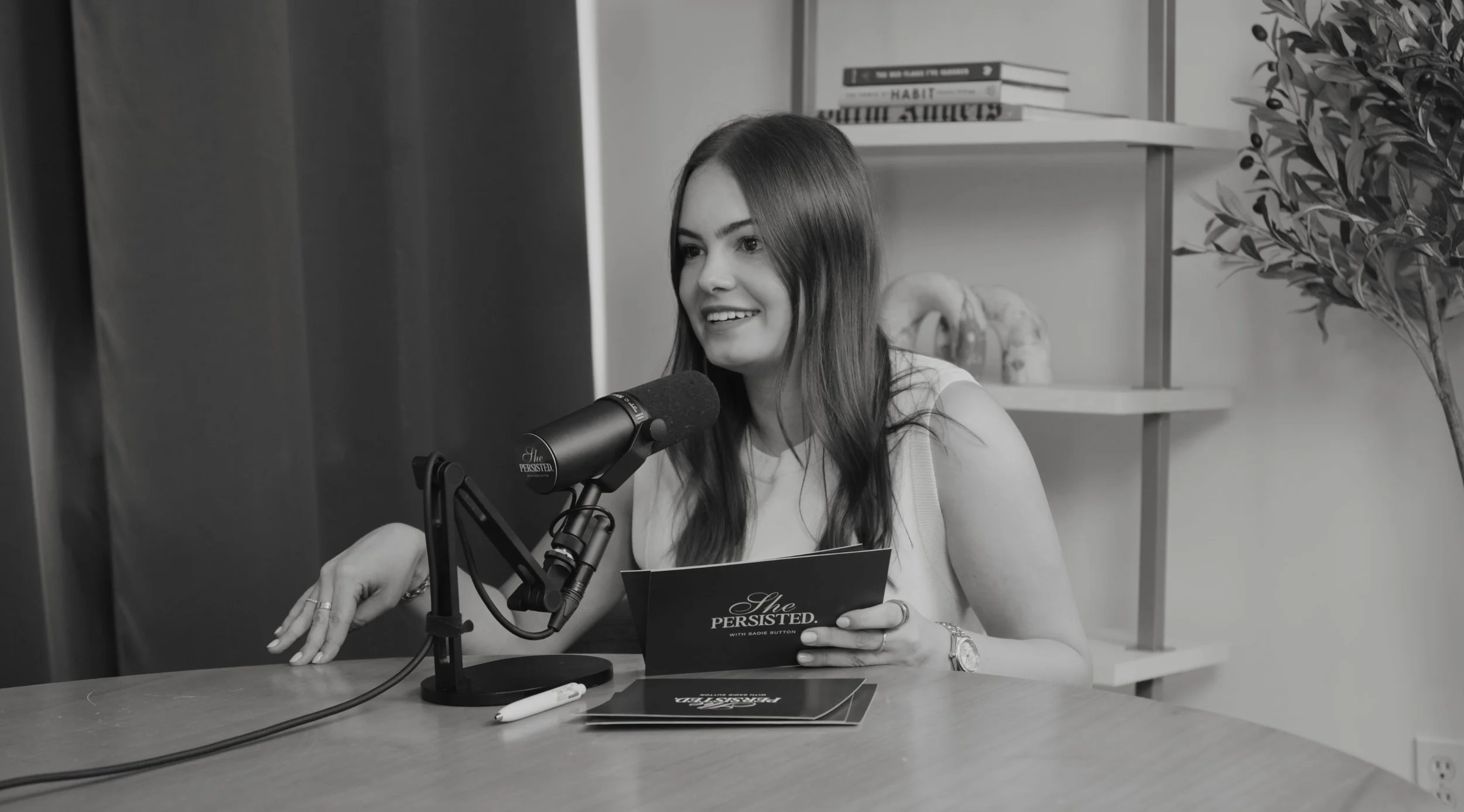
Sadie: [00:00:00] Welcome to She Persisted, the Gen Z Mental Health Podcast. I'm your host, Sadie Sutton. Let's get into it.
Tara: if somebody is listening to this and they're struggling with anxiety, I want people to really understand
Dr. Rosmarin: this is where, I think people get it, wrong,
Ken Ginsburg: there is real anxiety.
There's no question about that. And we need to take away the shame and stigma,
Beth: We get so used to the narrative and the dialogue that we've been telling.
Nicole: The answer isn't just putting the lid on it, getting really good at distracting ourself away from it and marching toward this idealized idea of what happy is.
Dr. Rosmarin: When we learn to embrace our anxiety, I think it is a key to unlocking human potential, almost like no other.
Sadie: Hello, hello and welcome back to She Persisted. If you have ever thought to yourself, why am I so anxious all the time, or why can't I, calm down just like everyone else does? You are not alone. Anxiety is one of the most common mental health struggles,
but even with all the awareness out there, a lot of us don't fully understand why we're feeling anxious or how to stop. So in today's episode, [00:01:00] I have put together a ultimate anxiety mashup. We have a compilation of the most powerful insights, research and advice from some of my favorite. She persisted guests.
We have psychologists, therapists, professors, bestselling authors. Really a round table of people who have spent their careers studying anxiety and helping people overcome it. So you will learn what is happening in your brain and body when you're anxious, why some people are more prone to anxiety than others and how to use coping skills that actually work in real life when you are in an anxiety spiral.
We will talk about the myths that make anxiety worse and some small shifts that can help you start to feel like yourself again. So whether you've been feeling constantly on edge, overthinking everything, are just ready to understand your anxiety once and for all.
This episode is for you. Let's dive in.
What is anxiety? Why do some people feel anxious, and how do we get to a state of having clinically significant anxiety versus just feeling anxious about a situation?
Dr. Rosmarin: So fear and [00:02:00] anxiety are actually the exact same physiologically from a neural standpoint. The symptoms are the same. , and like, let's talk about the symptoms of anxiety, right?
So you got a pounding heart, labored breathing, your muscles start to tense and all of that happens because adrenaline is going through your blood. Epinephrine is being released a neurotransmitter in order to start this. process to get you mobilized to act. So the symptoms of fear, if you've ever had a fear response and your stomach is in knots, well that's because physiologically your body is shutting down your stomach.
You don't need to digest when you're running away from, right? You just got to make sure you get the heck out of the way or you're able to fight it. Like it doesn't matter what you had for breakfast. You have to survive the moment. And anxiety is the exact same, but there's one tiny difference. It's not necessary because there's no actual threat in front of you. The threat is in the mind's eye. But that doesn't mean that anxiety is bad. This is where, I think people [00:03:00] get it, , I would say wrong, to be really bold. And if you have a misfire of your fear system, which is essentially what anxiety is.
It's a misfire of the fear system. It doesn't mean that something is broken. It doesn't mean that, you know, , something's pathological. It doesn't mean that there's a disease that is present. What it means is that your body is priming itself. If you need that fear response, it's going to be available to you.
I don't know about you, I would prefer to have my fear response intact and accidentally go off every once in a while than not to have it at all, and then you can get into serious trouble if you don't have a fear response.
Tara: this is something that I've recognized from my own life and what I've seen with my clients and patients as that, I believe there's three pathways that can ignite anxiety.
The first pathway is triggers in your environment. So something like a sight sound, smell, feeling, taste, whatever can trigger an emotional memory that's been [00:04:00] stored in your amygdala. So that's one. Another way that I think anxiety can be ignited as by our thoughts, you know, what are we telling ourselves?
What are we worrying about? What are we thinking? Because your thoughts can activate the right. They can essentially scare your amygdala into activating your anxiety. And then the third way is gut health is internal stressors because. If something's going on inside your body, you know, you're a Migdal and Vegas nerve they're communicating with each other.
And if your medulla perceives a threat inside your body, it's going to activate your stress response. So those are the three ways that I feel anxiety can be active in.
right now, I think people think what is igniting their anxiety is their worries.
We live in a very stressful world right now. And I think people perceive that their anxiety as a result of their thoughts. But I, I always encourage people to get curious, like, When you feel anxious, just sit with it, you know, what, what is it [00:05:00] guiding it? Is it your thoughts? Is it something in your environment, you know, is your blood sugar low?
And I think if people really sat with her anxiety, they'd be surprised that it's not their thoughts that ignited it it's that they had a physical sensation and then they put a thought to that
Judy: so these are things that we learned from childhood, from the most important adults that were with us in our lives around that time for most people it's parents, but it can also include teachers, coaches, and any other important adults. You learn lessons from them, you learn how they deal with conflict in the world, how they problem solve.
You also listen to what they're telling you. So if had a parent who was overly. Anxious, despite their best intentions. They're just trying to protect you. It may cause you to start to become a little overly anxious as you grow older. And then whenever there is a challenge ahead, it makes you feel a little bit insecure.
Like I'm not sure if I can do this. Some of those parenting messages come back as an adult in your own voice
Madeline: so when you experience, stress there are two [00:06:00] processes that are going on. So it's, you know, your autonomic nervous system and then your HPA access. So the autonomic nervous system is that parasympathetic and sympathetic. So everyone knows the typical example of like, I dunno like a bear or something scares you, but you know, that could be like someone following you down an alley you know, in terms of a stress that could be like you ruminating and thinking about a test.
You know, all of those have like the ability to trigger this autonomic response and this hormonal response. So just to kind of break it down a little bit more in the brain, the amygdala is that place in our brain, that's kind of processing that fear so when we're feeling that kind of fear and the amygdala that has connections to the hypothalamus, which the hypothalamus is kind of the hormonal response center. So the amygdala kind of triggers that neural response, which is the sympathetic autonomic nervous system. And then also triggers a hormonal response.
So the [00:07:00] neuro-transmitter response is going to be. A faster response and it's going to be epinephrine and norepinephrine in the body. And that's kind of like mobilizing your body for an attack. You know, it sends like blood to your muscles, takes it away from digestion, kind of mobilizes resources in an evolutionary fashion.
When we used to be like cave people, you know, fighting off an actual attack. And then as far as the hormonal response, that's going be. know, the hypothalamus interacting with the adrenal glands, and that's going to be sending that cortisol throughout your body, which is also, I think we think about cortisol kind of the stress hormone is a bad thing, but in the short term, it's, you know, hugging you alive.
Yeah. It's what keeps you alive when something really stressful is going on. So that response is not a problem at all. And that's like our body helping. What is a problem is either in chronic stress where that stress goes on too long, or when the stressor is too intense and the functioning [00:08:00] of our body can't like tamp down on the response.
So our cortisol signaling gets all off and also like our neuro-transmitters signaling gets all off.
Sadie: Are there any popular misconceptions or stigmas about anxiety that you want to address, debunk and demystify for the audience?
Ken Ginsburg: I acknowledge that there is real anxiety.
There's no question about that. And we need to take away the shame and stigma, come up with the plans to support this generation and humans in general. Let's be clear. But let's also be clear that them showing up to the emergency rooms and their self-report, is an act of tremendous bravery.
Yeah. And is the beginning of what I hope to be, the shattering of the stigma that prevents people from getting help. Yeah. Right. Adolescence is this unique time where you're figuring out who you are, your head is spinning, let's support them [00:09:00] through it. But let's also take some responsibility as adults for the world that we are creating that is anxiety provoking.
Sadie: Yes.
Dr. Rosmarin: I think there's cognitive shift that we have to have, you know, in our culture, if you have anxiety and you go to a physician's office, they will say you have a disease. There's something wrong with you and we need to take care of this. And even any anxiety, any level of anxiety, any level of worry, and you go to a physician's office, you will come out with a prescription for a benzodiazepine.
And I think we need to set the first step before trying any skills again, is just resetting Our perspective that all human beings have anxiety. This is the same as a fear response, which is actually healthy and adaptive. It's simply a misfire of it. There's nothing wrong with you if you experience anxiety, and it doesn't mean that you can't handle the symptoms, and that something is dangerous, that this shouldn't be happening.
No. It's like working out at a gym. It's like breaking a sweat. You know, I wish that was [00:10:00] taught in grade school, in high school. You know, I wish that teachers and educators would say, Hey, you're feeling uncomfortable?
Fantastic. That's your gym. That's your emotional gym. That's your opportunity to build emotional resilience, to build strength of character. But by the way, just as you can put too much weight on your , you know, dumbbells at the gym and strain yourself. You can also do the same thing emotionally. So it can't be too much just because you can't see it doesn't mean it's not real or tangible.
So it has to be titrated to your, where you're at next. It should be moderately uncomfortable, but not super uncomfortable we want to avoid those situations where you're stretching too far.
Beth: When I work, you know, I have a lot of clients who are adults and alive who are teens and my adult clients, you know, and I can put myself in this bucket. It's like, people get used to saying I'm suffering. I'm anxious, I'm anxious. And then after some time together, my client may say, Oh, actually, I don't think that's anxiety [00:11:00] anymore. I think it's fear or I think it's worry, or I think it's sadness because we get so used to the narrative and the dialogue that we've been telling.
And my whole sort of Passion is to rebrand mental health because read it be normal. Like we're human.
Sadie: I'm curious what happens when we cope with anxiety ineffectively? What are the consequences to not approaching this as we quote unquote should be?
Nicole: To really, simplify anxiety.
Anxiety is a symptom of immobilized or overly energetic nervous system. So being a chronically anxious person for as long as I can remember, I can attest to as much as I desperately want it, peace, quiet, to slow down, to have nothing to do. It was so uncomfortable.
I was nearly crawling. Skin, my mind was racing. I had all of this pent up, agitated energy that made sitting stillness, slowing down all things that the nervous system needs to be able to do when it downshifts from that sympathetic, anxious [00:12:00] based response into the more parasympathetic, grounded, safe response.
It actually feels so foreign and so uncomfortable that my, my tension in my body, the fact that it never felt safe just to slow down. I was getting all of these messages of why I shouldn't be slowing down, that I, I couldn't embody. That's safety. So I think that's an important part of this conversation, especially for the anxious individuals that are listening.
As much as you might hear me profess how important it is to be restful, to take a moment of peace and of stillness, your body might not be sending that message that it's safe to do that in that moment. To your mind, your tension in your muscles, your elevated heart rate, your quickened breath might be sending the complete opposite, that you better get your butt up off that couch and tend to whatever is threatening in my environment.
Even of course, if there's nothing present there, which is why? Working holistically, coming to that realization that I can't just white knuckle it, I can't just want peace. I have to teach my body peace so that in those [00:13:00] moments I can actually have the opportunity to slow down.
Stop. Yeah. Allow my nervous system to rebalance.
Dr. Rosmarin: A lot of people, when we feel anxious, it's uncomfortable.
And since it's an uncomfortable emotion, we tend to lean away from it. We tend to not allow ourselves to experience it fully. We tend to be more, , avoidant of it and because of that, lot of the processes that we use, They're really aimed at getting rid of anxiety or pushing it away, and that's usually where the anxiety gets magnified.
In reality, anxiety is not dangerous. I think it can get disordered when we become super sensitive to it, and then we are afraid of it, and we run away from it through all these different Coping mechanisms , Avoidance, behavioral avoidance, not going in situations that make you feel anxious. If we spend our lives trying to get rid of this emotion, I have seen patients become very inward focused, very self [00:14:00] centered. I can see people becoming, , more angry.
Because when other people make them feel uncomfortable, they don't want to show any vulnerability. So better to just blame the person or say, you know, you're a jerk than to say, Hey, like that really makes me feel uncomfortable and I kind of need your help. , so I think if we respond to anxiety in the way that, that many people do, which is by becoming more insular, try to avoid it, trying to judge ourselves, catastrophizing.
You know, I think we end up spinning our wheels, becoming more disconnected, and we're seeing that happen more and more. We're seeing violence increase in our society. When other people disagree, it's, there's no civil disagreement anymore.
Right? Yeah. You made me feel uncomfortable, and therefore we don't have any relationship at all, like the cancel culture piece.
Conversely, though, when we learn to embrace our anxiety, I think it is a key. To unlocking human potential, almost like no other. [00:15:00] I think it can make us more empathic and more aware of other people's emotions. Because if I'm feeling uncomfortable and I let myself feel that, I can see, oh wow, that person's feeling uncomfortable too.
And like, you know, this is like the therapist anxiety, which, we don't really talk about, but a lot of clinicians, myself included, have, you know, reasonable amounts of anxiety. And that can help us to understand like, well, I know what it's like to struggle, so, you know, I, I can be there for my patients, for my colleagues in, in ways because I understand them.
I understand those emotions.
Laura: So with anxiety is high neurotransmitters in the brain, high neurotransmitters in the gut. So we're eliminating super quickly. This is why, like, if you ever have to go give a speech and all of a sudden you're like, I have to go to the bathroom like, run and have to go like poop. And you're like, what the heck was that?
Because this body is just anxious and it wants to eliminate. So you'll see diarrhea, you'll see cramping, you see a lot of heartburn and indigestion and things like that because we're not assimilating the nutrients. We're just rushing to get it out. And then anxiety often hits the adrenals. [00:16:00] So hits the thyroid hits the liver and the pancreas, like everything is just being stripped of nutrients. And this is where the body is going to start to show up where it's not just anxiety, right?
Like we're, it's never that we also have other health issues that start to come up. When it's a chronic thing, when it's a chronic state that it's day in and day out.
And I think it's like three weeks max or three months that you have to be in it and that's considered chronic that's when we start to see the body being like, I need nutrients, help me. Like, I can't keep pumping this to your heart, like what is going on? Cause it doesn't know. Right?
Ken Ginsburg: But
Let's remember being distressed, Being anxious about things that are worrisome. These are signs of mental health. If you are anxious about things that should create anxiety, then you are mentally healthy. What makes you not healthy is if you cope. In a way that is harmful to you? Yeah. Point one and 0.2, [00:17:00] if you are persistently anxious if you can't function because your mood is affected, then you need therapy and treatment.
Mm-hmm. But Mental health is not the same as being happy. That is one of the great. Problems that we as a society, not this generation, we as a society have, and that we as parents have. We think our kids are supposed to be happy all the time. Yeah. Well, they're not. They're supposed to learn how to manage a world that is complex.
That means sometimes being sad, sometimes being anxious, sometimes being angry, and sometimes being exuberant, joyful. What we want is to know how to cope. Mm-hmm. We can cope in negative ways that are the quick, easy fixes, but very harmful and create more problems like drugs make you feel great for a few minutes to destroy your life.
Sadie: Yeah.
Ken Ginsburg: Right. or if we change our eating patterns, if we have [00:18:00] unhealthy relationships, those are unhealthy ways of coping. Mm-hmm. Let's take it up a level and Let's remember what adolescence is.
Adolescents is the time we're reforming our identity. The big questions are, who am I? Am I normal and do I fit in? Which means you are looking in your environment for answers to Those questions? Yeah. Who am I? Am I normal? Well, if the world is telling you that who you are is semi broken and that what is normal is to be highly anxious, then you'll absorb that messaging.
So absolutely it backfires. It backfires for this phase of development, but more so it's not accurate. It's not accurate. So when we talk about adolescents being anxious let's , begin looking. At the reflection in their eyes. And understand what they're seeing.
And what they're seeing is a society that's actually [00:19:00] divisive, not really handling a lot of problems well. So I would say that there's a certain normalcy to being anxious.
Meg: You know, a couple of things come to mind. One is it's called the Nacebo effect. So the. Placebo effect is the power of positive expectations. If people think they're going to get better from something, they tend to get better.
The Nacebo effect is the power of negative expectations and you think I'm not going to get better. So I will have clients come in and say, Oh no, I saw on the internet, I have anxious attachment style and no one's ever going to love me. And I, have issues and who wants to be with someone who's anxious.
And so there's that. The power of negative expectations that they think this is something I have something about me, that can't change. So, You know, the power of negative expectations is one. The other is just the lens that I think I hear people say, well, because of my anxiety, I, or because of my whatever, I, that everything is understood through that lens, and it can be a very [00:20:00] limiting way of thinking about yourself.
And sometimes it's like, well, I don't actually think That is why you're doing X, Y, or Z. So maybe we should, you know, imagine looking at yourself differently. And then I guess the last thing is there's sort of a mating and friending that goes on where people sort of huddle up or cuddle up with people that they feel like share or understand their diagnoses, , which.
Can be useful, but it also can be limiting because I often want people to group up with people who see their strengths and maybe share their strengths and not necessarily just their struggles.
Sadie: What your advice for someone currently struggling with anxiety? Any tips or coping skills that they can implement?
Tara: I think if somebody is listening to this and they're struggling with anxiety, I have a couple of things.
I would, definitely encourage movement. If you can get your heart rate up for 30 minutes a few times a week, when you get your heart rate up and you're moving, your amygdala thinks that you're escaping danger. And so it [00:21:00] thinks, okay, you know, they've exceeded. Danger. I no longer need to be activated and it'll close that anxiety loop for you.
I want people to really understand when your anxiety activates, it activates your nervous system, your sympathetic nervous system and energy is mobilized within me. And if you don't burn off all that energy that was mobilized, it becomes stored in your body.
So that's also like a really good reason to move your body when feeling anxious. The other thing I would encourage people to do is prioritize, sleep. Like, are you getting good sleep quality? And I'm not saying, oh, I sleep eight hours. Are you sleeping good? Because when you don't sleep good, it pisses off your amygdala and therefore you feel anxious the next.
The other thing I would encourage probably is just grounding, like really grounded in your body, send your amygdala signal of safety. Let it know that you're safe, because if you're able to calm your nervous system, whether you go for a walk in nature whatever you can do to just really [00:22:00] ground yourself in your environment, in your body.
Going to send that signal of safety and your Migdal is going to think you're okay. And therefore it's going to basically stop activating.
Judy: There's a really easy way to do this for a lot of us. We end up. Not thinking about our thoughts a lot, because most people have 50,000 or more spot fragments in a day. There's no way that we're consciously paying attention to all of them. But you always notice when you have a negative emotion. or if you do something that you wish you didn't do, or a man, I don't know why I did that.
Now. I'm gonna have to go apologize to someone, you know, when you do something and you wish you hadn't done it. So the next time that you notice a negative feeling or you notice an action that you immediately regret and wish you didn't do ask yourself this one. Very simple question. What was I thinking just before.
If you're able to do this, you're going to be able to catch your thoughts in real time. And you're gonna be able to see the kind of [00:23:00] thoughts that led you down this path, where you then started to feel bad and have negative emotions, or you started to do things that you wish you didn't do. there's a predictable sequence.
So it's thoughts leads to feelings and behavior. So. If you can stop the next time you notice a negative feeling or a negative action that you wish you didn't do. And just ask yourself this question. What was I thinking just before this, you're gonna start to notice your thoughts and also notice that there's patterns.
So a lot of people will find, oh, wow. I really am a catastrophizer. I'm always thinking that the worst thing is gonna happen. And that's what leads me to feel anxious and then if you notice these types of thoughts, then you know how to catch them more and how to work with them.
so for most people they're gonna find that there are certain themes and their thoughts that come up over and over. And by doing this very simple exercise, you're gonna be able to start to understand your own thought processes a lot more. And then you're gonna feel like you're more in control.
Nicole: I think the, greatest gift, that we could give ourselves is a relationship with our emotions. even when the emotions that we're feeling are really big. I think a lot of messaging in [00:24:00] society gives emotions a bad rap.
This idea that it's to be avoided or that happiness comes when we're not feeling anything but joy at all times. And I'm saying this to a version of myself as well, who in absence of having, you know, a supportive, attuned. Caregiver in my home, I shut down all of my emotions. I learned how to avoid and to channel and to only do the things that felt useful to me and validating for me, and to stay away from all of the things that provoked any discomfort in my mind or in my body to just shut down the lid on all of my emotions and to really then limit my experience of life, my ability to tolerate the emotionality of living as a human being.
Life is meant to be felt. I think that's what colors us and our existence and our experience, the gift we can give ourselves is a relationship with our emotions being present to what is present for us. And if we don't have the safe space in our home, or the safe caregiver in their own balanced nervous system to help us out in those moments, we [00:25:00] can and need to find that support.
The answer isn't. just Putting the lid on it, getting really good at distracting ourself away from it and marching toward this idealized idea of what happy is. It's actually learning how to be stress resilient, how to go through hard, difficult emotions. So actually the many of you listening that are dealing with a lot of emotional, you know, overwhelming, upsetting.
Feelings. That's not to be avoided. It's about developing the skills, the resources, the community, the support to navigate those. Because the gift on the other side of that is such an ability to be resonant, to be empathetic, to truly understand what it is to be human.
So the takeaway, wherever we are coming to this awareness, exploring ourself in a new way is.
Integrate and make space for our emotions. Learning how to be present when they are indicating, you know, something that's happening for us. How to turn in and begin to understand, get curious, and to develop new ways of navigating [00:26:00] those. Again, it's not about avoiding our emotional world because again, that's what makes us and colors our emotional world, though it is about getting support.
Finding the safe containers, finding the safe relationships to begin to explore how to then safely relate to our emotion.
Dr. Rosmarin: I'm done with trying to get rid of our anxiety I think we need to change our relationship with this emotion and The first step even for clinical cases what you would call And even in severe cases, you know, sometimes it's even more so it's even more important for people with severe levels of anxiety To stop fighting it some of the best strategies When it's used in order to get rid of anxiety, it often can make things worse.
because if you're chasing getting rid of your anxiety, what you're essentially going to do is dump more adrenaline into your system in order to push it away.
Madeline: I think just knowing that whenever I feel a certain way, you know, whenever I feel anxious, I was feeling anxious yesterday that this is meant to help me.
This will [00:27:00] pass you know, this isn't that big of a deal, because I think before in my healing journey, I would get anxious and then I would be mad at myself for being anxious. And then I would be more anxious because I was mad at myself for being anxious. And then I just like, wouldn't you mean.
Leave the house. And I think now the biggest thing for me is self-compassion and as far as kind of like daily habits, it kind of, it looks like a lot of times where my phone is on airplane mode. It looks like a lot of meditation. It looks like being really mindful of.
The foods that I put into my body and drinking enough water, and I'm still in therapy now. And I, you know, see my therapist every two weeks. I'm always, you know, checking in with myself and I think another big difference now, too, is when I experience an emotion, I don't go to the old coping strategy of staying as busy as possible.
I pause with it. I get curious about it. I let the trigger exist in my body. I trace back to what is the story here? What is the truth here
Beth: something [00:28:00] else that is really helpful is, sometimes just writing, like just.
Sort of like a brain dump. So it's, there's no rules. There's no, it doesn't matter about like grammar or spelling or content just, you may write, like, I don't want to write any more. I don't want him to write anymore, but sometimes setting a timer for one minute, two minutes and you know, I just believe that there's, different ways.
To get to the same place of coming back to your truth. Right? So that may be using your breath to quiet down and maybe writing it may be talking, it may be moving. So any way that we can shift from that place of the stress or the struggle, I acknowledge it. Right. So to not avoid it, but like, all right.
Here's anxiety again, it's showing up, you know, let it move through, see where it is in your body. Move that part of your body. Right. So you feel anxious. Most of us feel anxious and our shoulders. Right. We can even like, just while we're sitting here right now, go [00:29:00] ahead and just place your feet on the ground.
And if you want to close your eyes, you can close your eyes for our listeners, and just take one big breath in together under the breath out
and again, a big breath down
and exhale it out.
And then again, notice your feet flat on the ground.
Feel your legs, but your palms actually be face down on your thighs and then start to lengthen through the base of your spine all the way up to your shoulders. Roll your shoulders.
And then let the muscles in your face, even soften,
you can even separate your teeth.[00:30:00]
And then just as much as your feet are connected to the ground, imagine that there is a. Thread right above the top of your head, gently lifting you up towards the sky and then settle back in.
Just notice how your body's feeling right now. Notice any emotions that are showing up,
checking with the thoughts in your mind.
And take a moment to really even
dealing to any of the challenging that emotions may be present or maybe around, and maybe it's fear or anxiety, stress,
and take just a moment and notice where you [00:31:00] feel that.
And then take about 10 seconds and just move that part of your body. So for me, I'm rolling my shoulders forward and back, maybe it's in your nephew or your neck in one direction or the other
it's in your belly. You can kind of do a cat cow seated.
And I'm actually going to allow for about 10 seconds of quiet while wherever you are, you moved through this
right here with you.
And then go ahead and pause and place your [00:32:00] hands. And wherever that part of your body was your belly or your shoulder,
again, one breath thing. Okay.
And notice how you feel now.
Sadie: If there is one thing you remember after listening to this week's episode, I hope it is this, your anxiety is not random and it's not your fault. It is your brain and your body trying to protect you. And once you understand what it's doing and why you can finally start to work with your anxiety instead of against it.
Every expert you heard today offered one shared message. Healing is possible. Anxiety is treatable. It is not a permanent experience. So whether that means slowing your breathing, changing how you talk to yourself, or challenging the stories that your mind keeps replaying, it all starts with awareness and [00:33:00] understanding.
So if this episode resonated with you, please, please, please share it with a friend or family member and leave a review on Apple or Spotify. It helps more people find the podcast. More people get support in their mental health journey and helps people feel less alone. And it also is amazing when you guys find these episodes because I do put so much thought and work into them and it means the world that you guys are listening and find them helpful. You also also, if you leave a review, you'll be entered in this month's coffee giveaway if you DM me a screenshot on Instagram. At, at She Assist to Podcast. Every month a listener gets a coffee on me for leaving a review. So go ahead and enter that and if you're watching or listening on Spotify, answer this week's q and a and tell me which insight helped you the most.
I'd love to know what resonates so we can do more episodes on those things in the future. And if you want more, you wanna hear more information from the experts you just heard from. You want longer conversations about these things.
Every single episode that was clipped in this episode, is linked in [00:34:00] the show notes and can be found@shepersistedpodcast.com. Thank you for listening. Remember, you're not broken. You're human. Your anxiety makes sense and it can get better.
If you enjoyed this episode of She Persisted, make sure to leave a review, subscribe, and share with a friend or family member. Follow along at at She Persisted podcast on TikTok, Instagram, YouTube and more for bonus content. Thanks for listening and keep persisting.
© 2020 She Persisted LLC. This podcast is copyrighted subject matter owned by She Persisted LLC and She Persisted LLC reserves all rights in and to the podcast. Any use without She Persisted LLC’s express prior written consent is prohibited.
























are you currently at a low point with your mental health? do you hate when people tell you “it will get better”—mostly because you don’t believe it ever will? in today’s solo episode, i’m talking about depression recovery, suicidal thoughts, hopelessness, asking for help, and what actually helped me start believing that my life could feel different. eight years after being hospitalized for severe depression and suicidality at age 13, i’m looking back on the doubts and fears i had throughout recovery—and answering the questions i wish someone had answered for me then. if you’re asking yourself things like will i always feel this way? what if nothing works? what if i’m not struggling enough to deserve help? what if asking for help makes everything worse? this episode is for you.